
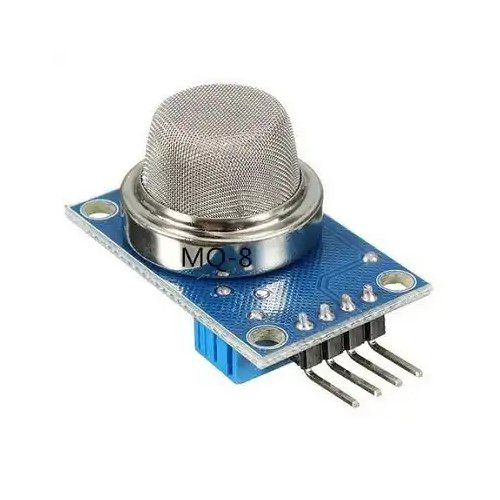
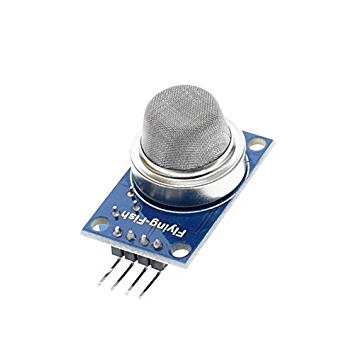
MQ8 Gas Sensor Module Hydrogen Gas Sensor
৳ 160.00
- MQ-8 Hydrogen Gas Sensor Module (H2)
- High Sensitivity Detector for Arduino & IoT Safety
- Made in China
Ensure safety and precision in your clean energy projects with the MQ-8 Hydrogen Gas Sensor Module. Specifically calibrated to detect Hydrogen (H2) gas, this module is an essential component for developing gas leakage alarms, hydrogen fuel cell monitoring systems, and industrial safety devices.
Unlike generic gas sensors, the MQ-8 utilizes a Tin Dioxide sensitive layer that offers exceptional selectivity to Hydrogen while filtering out interference from alcohol, cooking fumes, and LPG. Compatible with Arduino, ESP32, Raspberry Pi, and other microcontrollers, it features dual output modes (Analog & Digital) for flexible integration into any project.
Key Features & Benefits
- Specific to Hydrogen (H2): Highly sensitive to hydrogen gas with low cross-sensitivity to other common household gases, reducing false alarms.
- Wide Detection Range: Capable of detecting concentrations from 100 ppm to 10,000 ppm, making it suitable for both minor leak detection and high-concentration monitoring.
Dual Output Modes:
Digital Output (DO): TTL Low/High signal. Adjust the onboard blue potentiometer to set a specific threshold (e.g., trigger an alarm if gas exceeds X level).
Analog Output (AO): Provides a variable voltage (0–5V) proportional to the gas concentration, allowing for real-time monitoring of gas levels.
- Rapid Response: Features a fast response time (< 10s) to ensure immediate alerts in critical safety applications.
- Visual Status: Equipped with a Power LED and a Digital Output LED that lights up when the gas threshold is reached.
Technical Specifications
| Feature | Specification |
| Sensor Model | MQ-8 (Metal Oxide Semiconductor) |
| Target Gas | Hydrogen ($H_2$) |
| Detection Range | 100 – 10,000 ppm |
| Operating Voltage | 5V DC $pm$ 0.1V |
| Heater Consumption | ~800mW – 900mW |
| Sensing Material | $SnO_2$ (Tin Dioxide) |
| Output Type | Analog (0-5V) & Digital (TTL 0/1) |
| Comparator Chip | LM393 |
| Preheat Time | ~20s (for testing), 24h+ (for calibration) |
Pinout & Wiring Guide
This module follows the standard 4-pin layout compatible with most breadboards and DuPont wires.
- VCC: Connect to 5V (External power is recommended as the heater draws ~150mA).
- GND: Connect to System Ground.
- DO (Digital Out): Connect to a digital pin on Arduino (e.g., D2) for simple “Alarm On/Off” logic.
- AO (Analog Out): Connect to an analog pin (e.g., A0) to read exact gas values.
How It Works
- Heating: The sensor contains a small internal heater (requires 5V) that warms up the sensing layer. Note: It is normal for the sensor to feel warm to the touch.
- Chemical Reaction: The core sensing material is Tin Dioxide ($SnO_2$). In clean air, its electrical conductivity is low.
- Detection: When Hydrogen gas contacts the heated sensor surface, the conductivity increases.
- Signal Conversion: The module’s circuit converts this change in conductivity into a voltage signal (0V to 5V) outputted via the AO pin. The LM393 comparator simultaneously checks if this voltage exceeds the limit set by the blue potentiometer to trigger the DO pin.
Common Applications
- Hydrogen Fuel Cells: Leak detection in hydrogen-powered vehicles or generators.
- Industrial Safety: Monitoring gas buildup in battery charging rooms (lead-acid batteries emit $H_2$ while charging).
- IoT Gas Alarms: Smart home safety devices that send phone alerts upon leak detection.
- University Research: Chemistry and physics lab experiments involving gas analysis.
Package Contents
1x MQ-8 Hydrogen Gas Sensor Module
Related products